Case file — PRJ-001
Kurt Safari.
A Kruger Park safari operator with a packed catalogue of tours and one job for the website: turn researchers into booked guests.
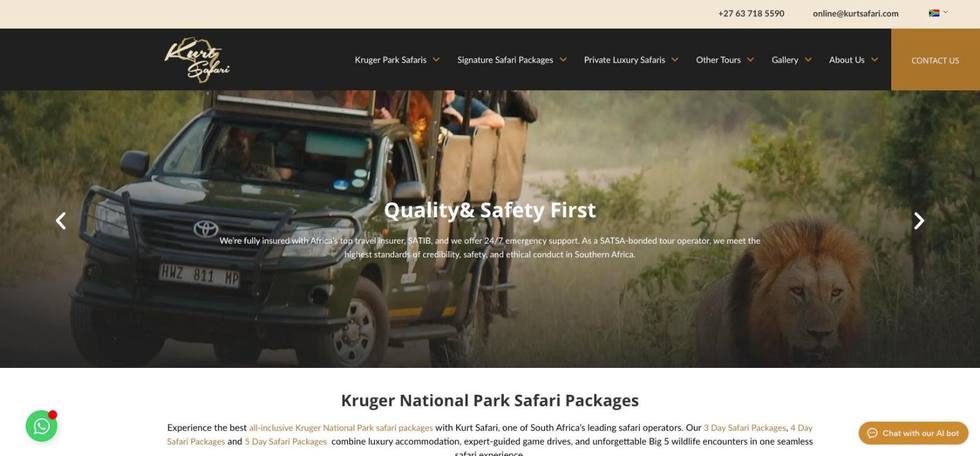
The brief
Kurt Safari runs Kruger Park safaris and is the top-rated operator on Tripadvisor for it — but the catalogue is wide: three, four and five-day packages, day safaris, private tours, and trips that run out to Cape Town, the Garden Route, Namibia and Victoria Falls, plus stays at Sabi Sabi, Kapama and Ndzuti. A guest arriving from a search does not want that whole list. They want the two or three options that match the days they have.
The build
We organised the site around trip length first, because that is the decision a traveller can actually make, and let destination and lodge sit underneath it. Enquiry sits on every package rather than behind a contact page, and an AI assistant handles the questions that arrive outside South African office hours — which, for a business selling to Europe and the US, is most of them.
Scope of work
- S-01UX/UI DESIGN
Trip length first, then destination. The wide catalogue organised around the traveller’s real constraint.
- S-02DEVELOPMENT
WordPress build the team extends as packages and lodges change season to season.
- S-03AI CHATBOT
A 24/7 assistant trained on the packages, so a 2am enquiry from Europe still gets an answer.
- S-04TECHNICAL SEO
Structured for Kruger package and day-safari searches, which is where the demand actually sits.
The details that mattered
- The 2am problem. Most enquiries come from timezones asleep to South African office hours. The assistant answers them, and hands over to a human when it should.
- Days available, not destinations. A traveller knows they have four days. They do not yet know they want Sabi Sabi. The site is built in that order.
- Enquire from anywhere. Every package carries its own enquiry path. Nobody should have to navigate to a contact page to ask about a trip they are already looking at.
- Tripadvisor rank, used properly. Being the top-rated operator is the strongest thing they have. It sits where a first-time visitor sees it, not in an about page.
Quick answers
Can an AI assistant handle safari booking questions?
For availability, inclusions and pricing questions, yes, trained on the operator's own packages. Anything needing judgement hands off to the team with the conversation attached.
What stack is the Kurt Safari site built on?
WordPress, tuned hard: stripped of builder bloat, image-optimised and structured for travel search terms.